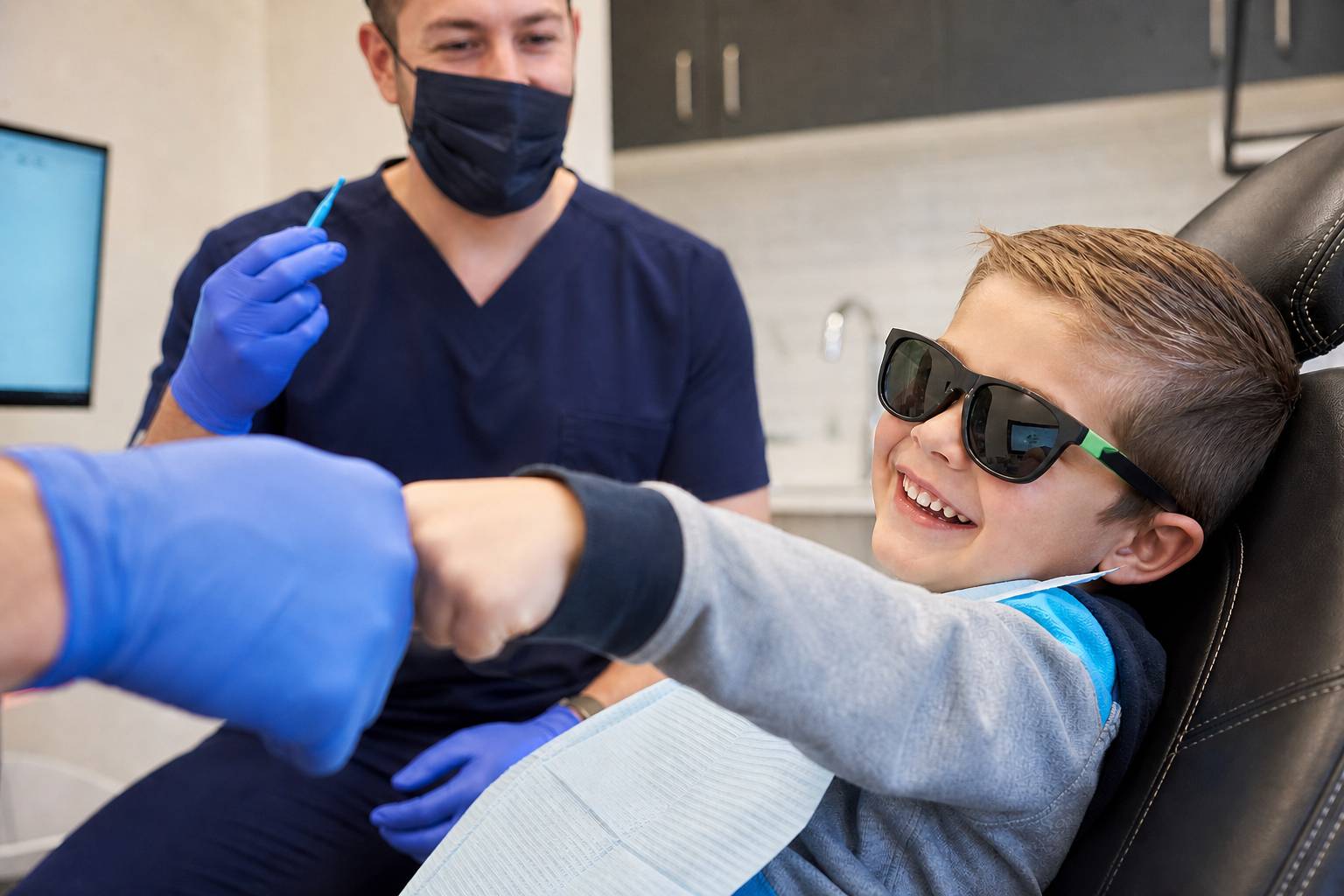
For generations, the rhythmic whir of a dental drill has been the primary source of anxiety for children—and the leading cause of “white coat” phobia for their parents. When a dentist traditionally says, “Your child has a small cavity,” the immediate mental image involves local anesthetic needles, loud mechanical tools, and a potentially traumatic afternoon. This cycle of fear often leads to dental avoidance, which only allows oral health issues to worsen over time.
At Pedodontic Associates, we are proud to announce that for many of our patients in Aiea, Honolulu, and Maui, that cycle is officially being broken. With the introduction of Curodont™ Repair Fluoride Plus by vVardis, we can now offer a revolutionary, non-invasive treatment that repairs early-stage tooth decay without a single shot, a single second of drilling, or any removal of healthy tooth structure.
This isn’t just a new dental product; it is a fundamental shift in medicine known as Guided Enamel Regeneration. It is changing the way we protect Hawaii’s keiki by moving from “mechanical repair” to “biological restoration.”
The Science of Guided Enamel Regeneration: How It Works
Traditionally, if a pediatric dentist discovered a small “spot” of decay—often referred to as an incipient lesion, a “watch,” or demineralization—they essentially had two choices. They could either drill it immediately to prevent it from spreading, or adopt a “watch and wait” approach, essentially letting the tooth get worse until it was “big enough” to justify a traditional filling.
Guided Enamel Regeneration provides a third, far superior option. Instead of waiting for a physical hole (cavitation) to form, we use the advanced chemistry of Curodont Repair Fluoride Plus to treat decay at the microscopic, molecular level.
The “Liquid Scaffolding” Explained
Curodont is not a traditional sealant or a surface-level fluoride varnish. It is a “smart” liquid based on a proprietary peptide technology. When applied to a tooth with early-stage decay, the liquid penetrates deep into the microscopic pores of the enamel that have been leached of minerals. Once inside the tooth, it undergoes a transformation to create a biomimetic scaffold.
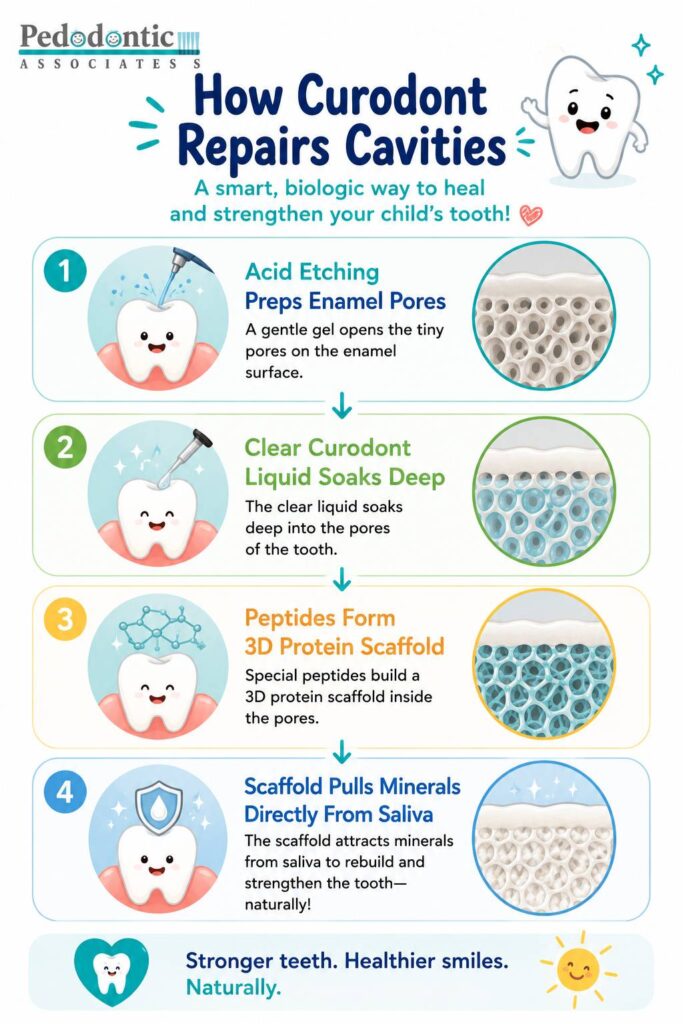
Think of this scaffold as a tiny, three-dimensional framework for minerals. This structural matrix perfectly mimics the natural protein framework of a human tooth during development. Once the scaffold is in place, it works in harmony with your child’s own saliva to attract calcium and phosphate ions. Over the following weeks, these minerals settle into the matrix, literally growing new tooth mineral (hydroxyapatite) inside the lesion. Instead of patching a hole with a synthetic foreign material, we are empowering the tooth to heal itself from the inside out.
The “Painless” 3-Minute Procedure: What to Expect
For families visiting our offices in Kahala, Pearlridge, or Kahului, we have streamlined the Curodont application to be the easiest, most stress-free part of your child’s visit. Because there is no need for local anesthesia or physical tooth removal, the procedure is entirely painless, silent, and tasteless.
- Zero Numbing Required: Because the treatment is non-invasive and does not involve removing tooth structure, there are no needles or shots. Your child won’t have to deal with a “heavy” or numb face for hours afterward.
- No Drilling or Noise: We preserve 100% of the natural tooth. There is no scary “whirring” sound or vibration, making it ideal for children with dental anxiety or special sensory needs.
- Fast and Flavorless: Our clinicians clean the area, apply the clear, tasteless liquid with a small applicator, and let it soak for just 5 seconds. It is so gentle that many kids don’t even realize a “procedure” happened.
- Immediate Activity:While there is no eating, drinking, or rinsing for 30 minutes afterwards, your child can return to school, sports, or play immediately. There is no downtime and no recovery period.
Direct Comparison: Why “No-Drill” is Superior for Kids
To understand why so many Hawaii parents are requesting this treatment in our offices, it helps to see how it stacks up against the old-school “drill and fill” method.
Unlike standard fillings, Curodont dries entirely clear, but because it is an advanced technology, its use is typically reserved for permanent adult teeth rather than primary baby teeth. Furthermore, not all of our pediatric dentists currently offer Curodont, as availability varies depending on your specific provider.
| Feature of Care | Traditional Pediatric Filling | Curodont Enamel Regeneration |
|---|---|---|
| Clinical Equipment | High-speed turbine drill (noisy/vibrating). | Gentle, single-use brush applicator. |
| Anesthesia Requirement | Local anesthetic injection (the “needle”). | No needles or shots required. |
| Enamel Preservation | Removes healthy and decayed tooth structure. | Preserves 100% of natural enamel. |
| Appointment Length | 30 to 45 minutes of chair time. | Applied in under 5 minutes. |
| Patient Experience | Pressure, noise, and “numb” face after. | Silent, painless, and zero downtime. |
| Insurance Status | Widely covered by standard networks. | Not covered by insurance; out-of-pocket. |
| Parent Investment | Minimal co-pay under insurance. | Clean investment of $80 per tooth. |
Advanced Diagnostics: The Baseline Age 4 X-Ray Rule
Finding these early watch spots when they are still small enough to be treated with non-invasive Curodont™ liquid requires advanced diagnostic mapping. Many cavities start in the tight spaces between teeth where standard visual mirrors cannot reach.
To catch these hidden lesions before they break through the enamel shell, our specialists implement a strict diagnostic protocol: the baseline target age for a child’s first routine bitewing X-rays is set at age 4. This represents the precise developmental window where the primary back molars have shifted and locked tightly against one another, and when most kids are able to tolerate taking x-rays of the back teeth. Low-radiation digital dental X-rays allow our team to see between these touching teeth, identifying early demineralization while it can still be reversed with non-invasive therapies instead of traditional drilling.
Who Is the Ideal Candidate for Curodont?
While Curodont is a massive medical breakthrough, it is essential to understand that it is a specialized tool for early-stage intervention. It is not a “magic liquid” for every type of cavity. We specifically recommend it for:
- Incipient Lesions (“The Watch List”): When we find small spots on Dental X-Rays that haven’t yet broken through the enamel into the softer dentin layer.
- Post-Orthodontic White Spots: It is very common for children to have “white spot lesions” or decalcification marks after their braces are removed. Curodont is the most effective way to restore the mineral density and appearance of these spots.
- Children with Special Needs: For kids who cannot tolerate the sensory input of a drill or the duration of a traditional filling, Curodont provides a way to treat decay without the need for pediatric sedation.
- Interproximal Decay: These are cavities forming between the teeth, which are notoriously difficult to treat with a drill without removing a significant amount of the healthy biting surface.
Note: If a cavity has already formed a visible “hole” or has reached the inner pulp of the tooth, a traditional Dental Filling or a pediatric crown will likely still be necessary to save the tooth.
A Comprehensive Look at Restorative Materials
At Pedodontic Associates, we believe in transparency. Restoring a tooth can take many forms depending on how deep the decay has traveled:
| Material Type | Primary Use Case | Best Feature |
|---|---|---|
| Curodont Repair | Early decay/White spots on adult teeth. | Regenerates real enamel tissue invisibly. |
| Fluoride Varnish | General prevention across all teeth. | Cost-effective surface enamel protection. |
| Dental Sealants | Pits and deep fissures of back molars. | Physical barrier against food particles. |
| Composite Resin | Actual holes, fractures, and deep cavities. | Strong, tooth-colored restorative structural patch. |
| Silver Diamine Fluoride | Severe decay/Hard-to-reach baby teeth. | Stops decay immediately but stains teeth black. |
Patient Feedback: Why Hawaii Families Trust Us
We know that choosing a dentist for your child is about trust. Here is what actual parents are saying about the gentle, patient-focused care at our various locations:
“I really like this place for my kids. They are so gentle and they take their time with them. My kids are always so excited to come back and they don’t have to be scared. The staff is amazing and very friendly.”
— Kiana W. | Verified Google Review for Aiea Office
“The dentists and staff are amazing. They are patient and kind, and they make sure the children are comfortable throughout their visit. My children actually look forward to their dental appointments!”
— Liana G. | Verified Google Review for Maui Office
“Excellent experience! They take the time to explain everything to both the parents and the kids. The environment is very welcoming and perfect for children who might be nervous about the dentist.”
— Derek S. | Verified Google Review for Honolulu Office
Frequently Asked Questions: Guided Enamel Regeneration
Does Curodont really work as well as a traditional filling?
For early-stage (incipient) cavities, clinical data suggests it is highly effective. Because it rebuilds the tooth’s internal density rather than just covering a hole, it offers a more “natural” long-term result. However, for large, deep cavities, a filling is still the standard of care to restore structural integrity.
Can any child receive this treatment?
Curodont is suitable for permanent adult teeth across various ages, from older children to teens. However, because every smile develops differently, our doctors will perform a comprehensive evaluation of your child’s oral hygiene and X-rays to ensure Curodont is the right choice for that specific tooth.
Does Hawaii dental insurance cover Curodont Repair Fluoride Plus?
No insurances currently cover Curodont Fluoride Repair Plus. (Parents will typically pay less out of pocket for a traditional filling but their child will need to undergo more invasive treatment. We charge $80 a tooth for Curodont while if they have HDS insurance, their co-payment for a two surface amalgam filling will be around $20 and a lot more for a composite or resin filling).
How long does the regeneration process take?
The “scaffold” is created in 3 minutes during your visit. The actual mineralization happens over the next 30 to 90 days as your child eats and drinks normally. You won’t see a “patch,” but the tooth will become structurally sound. We hope to see denser enamel on subsequent x-rays.
Are there any side effects?
None! Curodont is tasteless, odorless, and non-staining. Unlike Silver Diamine Fluoride (SDF), which turns the decayed area of the tooth permanently black, Curodont is completely clear and leaves no mark on the tooth.
Geographic Convenience and Insurance Transparency
At Pedodontic Associates, our team consists entirely of specialized pediatric dentists who have completed years of post-doctoral training to master the unique behavioral and developmental needs of growing smiles. We believe in providing clear, upfront operational transparency so local families can plan their care comfortably.
To help you navigate your family’s baseline benefits, our administrative team is always happy to verify your active insurance coverage and baseline benefits before your appointment. While our office does not routinely submit formal pre-authorizations for specific dental services, we work closely with you to make utilizing your insurance plan as simple and straightforward as possible.
Our centralized locations are designed to fit seamlessly into your family’s routine:
- Aiea Office: Located right by Pearlridge Center, providing a convenient hub for parents living across Central and West Oahu.
- Honolulu Office: Centrally positioned to serve busy parents living or working throughout our Honolulu dental office network.
- Maui Office: Conveniently situated to help neighbor island families access cutting-edge care through our dedicated Maui dental office hub in Kahului.
Conclusion: Proactive Care for a Fear-Free Future
At Pedodontic Associates, we aren’t just fixing teeth—we are building a future where children in Hawaii don’t have to grow up fearing the dentist. By adopting world-class technology like Curodont Repair Fluoride Plus, we can stop decay in its tracks and save your child from the unnecessary stress of traditional drill-and-fill dentistry.
Don’t wait for a small “watch” to become a big, painful problem. If you’ve been told your child has early signs of decay, or if you simply want the most advanced preventive care available, ask our team about Guided Enamel Regeneration today.
Contact Us today to schedule a pediatric consultation at our Aiea, Honolulu, or Maui office!
Medical & Legal Disclaimer:The content on this blog is provided for general informational purposes only and is not intended as medical advice, diagnosis, or treatment. Curodont is highly effective for incipient (early) decay but is not a substitute for traditional restorative work in cases of deep cavitation, pulp infection, or abscess. Always seek the advice of a qualified pediatric dentist. If your child is experiencing a medical emergency, including severe facial swelling, call 911 or proceed to the nearest emergency room immediately.