
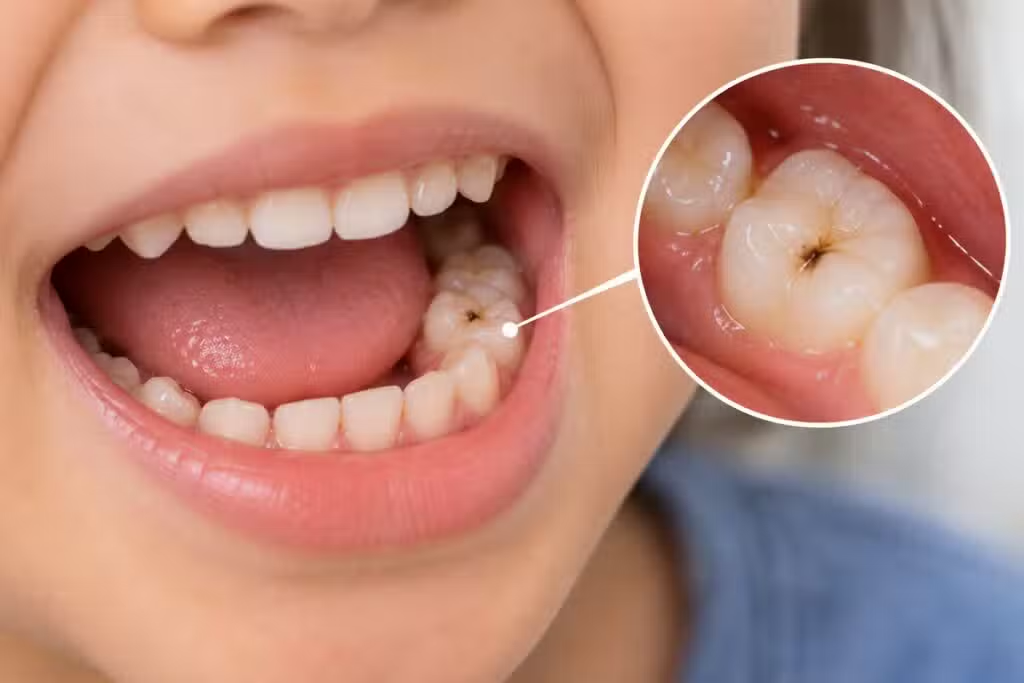
You notice a tiny black spot on your child's tooth while helping them brush. It wasn't there before, and now you're wondering: Is it a stain, or could it be a cavity?
Black spots on children's teeth can have several causes, including surface staining, plaque buildup, tooth decay, or changes within the tooth after an injury. Some are mainly cosmetic concerns, while others need dental treatment.
The important thing to know is that a black spot doesn't automatically mean your child has a cavity. But you can't reliably tell the difference by color alone.
At Pedodontic Associates, we help families across Oahu and Maui understand changes in their children's teeth. Here's what to look for, what you can do at home, and when to schedule a dental examination.
What Causes Black Spots on Children’s Teeth?
Dark spots can develop on baby teeth or adult teeth for different reasons. Their location and appearance may provide useful clues, but a dental examination is needed to determine the cause.
1. Surface Stains From Food, Plaque, or Bacteria
Some dark spots develop on the outside of a tooth rather than within its structure.
Pigments from foods and beverages may contribute to surface discoloration. Plaque that remains on teeth can also collect stains.
Some children develop a particular type of discoloration called black extrinsic stain. It may appear as dark dots or thin lines, often close to the gumline. This staining can be associated with certain bacteria in the mouth and does not necessarily indicate decay.
Black extrinsic stain can sometimes resemble cavities to an untrained eye. A pediatric dentist can examine the affected area to determine whether the discoloration is on the surface or associated with damage to the tooth.
2. Tooth Decay or Cavities
A black or brown spot may also be a sign of tooth decay.
Cavities develop when acids produced by bacteria in dental plaque gradually damage tooth enamel. As the decay progresses, affected areas may become discolored or develop visible pits and holes.
According to Mayo Clinic's guidance on cavities, tooth decay can cause white, brown, or black staining. Early cavities may not produce noticeable pain.
This is why we encourage parents not to wait for a toothache before having a suspicious spot examined.
Our cavity prevention and treatment services focus on identifying decay and determining the appropriate treatment based on the condition of the tooth.
3. Iron Supplements and Certain Medications
Some medications can contribute to dental discoloration.
For example, liquid iron supplements may leave dark stains on children's teeth. This type of staining is different from a cavity, although the appearance may be concerning.
If your child takes an iron supplement or another medication and you notice a change in tooth color, mention it during their dental visit.
Do not stop or change prescribed medication because of tooth staining without speaking to your child's healthcare professional.
4. Changes After a Dental Injury
Sometimes an entire tooth becomes darker rather than developing a small spot.
This can happen after an injury, even if the tooth did not break when the accident occurred.
Trauma may affect tissues inside the tooth, causing it to turn gray, brown, or darker over time. A color change alone does not tell us whether the tooth's nerve is healthy or damaged.
If your child recently fell, bumped their mouth, or experienced a sports injury, let us know. We may recommend an examination to evaluate the tooth and surrounding tissues.
5. Changes in Tooth Enamel
Some children have areas of enamel that developed differently from the surrounding tooth structure.
These areas may appear white, cream-colored, yellow, or brown. Enamel defects can sometimes make teeth more vulnerable to wear or decay.
Not every discolored area is a cavity. However, if the enamel is weakened or breaking down, we may recommend additional care.
How Can You Tell the Difference Between a Stain and a Cavity?
Parents often look for a simple visual difference between staining and decay.
Unfortunately, appearance alone isn't enough.
A dark line near the gums might be surface staining, while a small dark spot in a back tooth's chewing groove could reflect staining or decay. Some cavities also form between teeth, where parents cannot easily see them.
The following comparison can help you understand what your child's dentist will consider.
| What you notice | What it could mean | What to do |
|---|---|---|
| Thin black lines near the gumline | Surface staining, including black extrinsic stain | Schedule an examination to identify the cause. |
| Small dark spot in a molar groove | Staining or possible decay | Have the area checked for a cavity. |
| Brown or black area with a visible hole | Possible more advanced decay | Arrange a dental evaluation promptly. |
| An entire tooth turning gray or dark | Possible effects of a previous injury | Contact a pediatric dentist for an assessment. |
| Dark spot with tooth sensitivity or pain | Possible decay or another dental problem | Call a dentist promptly, especially if symptoms are worsening. |
These appearances are clues, not diagnoses. A tooth that looks relatively normal may still have decay, and a heavily stained tooth may not have a cavity.
A pediatric dental examination is the appropriate way to determine what is happening.
Can My Child Have a Black Spot Without Tooth Pain?
Yes. A child can have a dark spot on a tooth without experiencing discomfort.
Early tooth decay may not cause noticeable symptoms. Pain or sensitivity can develop as damage progresses, but some children experience few symptoms even when a dental problem needs attention.
Surface stains may also be painless.
That means the absence of pain cannot tell you whether a black spot is harmless.
We recommend arranging an examination when you notice a new or persistent dark spot, particularly if:
- The spot appears to be getting larger.
- Your child experiences sensitivity when eating or drinking.
- The tooth has a visible hole, chip, or rough area.
- The discoloration developed after an injury.
- Your child avoids chewing on one side of their mouth.
Call promptly if your child develops significant tooth pain, facial swelling, or fever with a suspected dental infection. Difficulty breathing or swallowing, or rapidly spreading swelling, requires emergency medical attention.
What Happens During a Dental Examination?
When you bring your child to us for a dark spot or discolored tooth, our goal is to identify what's causing the change and determine whether treatment is necessary.
We Examine the Affected Tooth
We'll look at the discolored area and surrounding teeth.
We may ask when you first noticed the spot, whether it has changed, and whether your child has experienced any pain or previous dental injuries.
Information about medications, brushing habits, and eating or drinking patterns can also be helpful.
We May Recommend Dental X-Rays
Not every dark spot requires an X-ray.
However, if we suspect decay that isn't fully visible during the examination, dental imaging may help us evaluate the affected area.
For example, cavities can develop between neighboring teeth, making them difficult to identify by sight alone.
Learn more about how we use dental X-rays to evaluate children's teeth.
We Discuss Whether Treatment Is Needed
The next step depends on what we find.
If the spot is surface staining: We may recommend professional cleaning when appropriate and discuss ways to manage further staining.
If the spot is early tooth decay: We may recommend preventive measures, including fluoride treatment, depending on the condition of the enamel.
If a cavity has formed: A filling or another restorative treatment may be appropriate, depending on how much of the tooth is affected.
If the tooth changed color after an injury: We may recommend monitoring or additional treatment based on the clinical findings.
We explain our findings and discuss treatment options with parents before proceeding.
Our approach is to recommend care based on your child's individual dental needs rather than assuming every dark spot requires the same treatment.

Can You Remove Black Spots From Your Child’s Teeth at Home?
It's natural to want to remove a dark spot as soon as you notice it, particularly if it appears on a front tooth.
However, avoid attempting to scrape, scrape away, or whiten the affected tooth at home.
Using sharp objects, abrasive products, or unapproved whitening treatments can irritate your child's gums or damage tooth surfaces.
If the discoloration comes from a cavity or a change inside the tooth, brushing harder will not correct the underlying problem.
Instead, focus on maintaining your child's usual oral hygiene routine while arranging an evaluation.
You can:
- Help your child brush twice daily with a soft-bristled toothbrush and an age-appropriate amount of fluoride toothpaste.
- Floss between teeth that touch.
- Encourage water instead of frequently sipping sugary drinks.
- Avoid excessive brushing pressure or abrasive products.
- Note whether the dark spot changes in size or appearance.
For children younger than three, the American Academy of Pediatrics recommends a smear of fluoride toothpaste about the size of a grain of rice. Children ages three through six generally need a pea-sized amount.
Our pediatric oral hygiene guide offers more information about brushing and flossing.
What About Black Spots on Baby Teeth?
Some parents wonder whether dark spots on baby teeth require attention if those teeth will eventually fall out.
The answer is yes. Baby teeth deserve the same careful evaluation as developing adult teeth.
Baby teeth help children chew and speak, and they maintain space for the adult teeth developing beneath them.
When decay affects a baby tooth, the problem can progress and cause discomfort or infection. Depending on the child's age and the affected tooth, early tooth loss may also affect spacing.
At the same time, not every stain on a baby tooth requires restorative treatment.
The goal is to identify the cause before deciding what needs to be done.
How to Help Reduce Staining and Tooth Decay
Some discoloration cannot be prevented through brushing alone, particularly when it is related to medications, injuries, or enamel development.
Still, consistent dental care can help reduce plaque buildup and lower the risk of cavities.
Make Brushing and Flossing a Family Routine
Young children often need help cleaning their teeth thoroughly, especially the back molars and areas near the gumline.
Use fluoride toothpaste in the appropriate amount and help your child clean between teeth once neighboring teeth touch.
If brushing has become a struggle, ask us for practical suggestions suited to your child's age.
Be Mindful of Frequent Sugary Snacks and Drinks
Bacteria in plaque use sugars to produce acids that attack tooth enamel.
Frequent exposure to sugary drinks and snacks can increase the risk of decay, particularly when teeth aren't cleaned adequately.
Offer water regularly and try to limit repeated sipping of sweetened drinks throughout the day.
Keep Regular Pediatric Dental Checkups
Routine dental examinations give us an opportunity to identify early changes before your child experiences significant symptoms.
We generally recommend checkups every six months, although some children may benefit from a different schedule based on their needs.
Our team can also discuss fluoride treatments and other appropriate preventive measures.
Have Questions About a Black Spot on Your Child’s Tooth?
A black spot might be surface staining, a cavity, or a change related to an earlier injury. You don't need to determine the cause on your own.
At Pedodontic Associates, we care for infants, children, and teens at our three Hawaii locations.
Our pediatric dental team can evaluate the discolored area, explain what we find, and recommend appropriate next steps.
Contact the office most convenient for your family:
| Our office | Location | Phone |
|---|---|---|
| Pearlridge Office | Aiea, Oahu | 808-487-7933 |
| Kahala Office | Honolulu, Oahu | 808-735-1733 |
| Maui Office | Kahului, Maui | 808-877-0066 |
Our Pearlridge and Kahala offices also offer Saturday appointments for families who need additional scheduling flexibility.
For non-urgent questions and office information, visit our contact page.
If you've noticed a new black or brown spot on your child's tooth, call us to schedule a dental examination. Finding out what caused the discoloration is the first step toward deciding whether any treatment is needed.
Medical disclaimer: This article is for general educational purposes and does not replace an individualized dental examination, diagnosis, or professional medical advice.