

For some children, brushing their teeth is difficult for reasons that have little to do with motivation. The taste of toothpaste may be overwhelming, holding a toothbrush may be physically challenging, or unfamiliar sensations may cause distress.
If your child has sensory sensitivities, a developmental disability, or a condition affecting movement, a standard brushing routine may not meet their needs.
At Pedodontic Associates, we provide pediatric dental care for children with different physical, developmental, and emotional needs. We also help parents adapt daily brushing and flossing routines.
Here's how to make toothbrushing more manageable while supporting your child's oral health.
Why Toothbrushing Can Be Difficult for Some Children
Brushing involves several sensations and movements at once. Children must tolerate the toothbrush, accept the toothpaste, and remain in a position that allows their teeth to be cleaned.
Some children experience challenges such as:
- Sensory sensitivity: Toothpaste flavors, foaming, or bristle sensations may feel uncomfortable.
- Limited coordination: Holding and moving a toothbrush can be difficult.
- Positioning challenges: Some children need additional head or body support.
- Communication differences: A child may struggle to explain what feels uncomfortable.
- Strong gag reflex: Brushing certain areas may trigger gagging.
These challenges vary. A technique that helps one child may not work for another.
The American Academy of Pediatric Dentistry (AAPD) recommends adapting oral healthcare to individual needs, including physical abilities and sensory considerations.
Identify What Makes Brushing Difficult
Before changing your child's entire routine, identify where the difficulty begins.
Does your child tolerate brushing without toothpaste? Can they brush their front teeth but resist cleaning the back teeth? Do they struggle to hold the brush?
Use these observations to guide adjustments.
| Challenge | Adaptation to Try |
|---|---|
| Strong toothpaste flavors | Choose a milder-flavored fluoride toothpaste |
| Difficulty gripping | Try a toothbrush with a larger handle |
| Sensory discomfort | Introduce brushing gradually |
| Difficulty standing | Use a stable, supported seated position |
| Unpredictable routine | Introduce a visual brushing schedule |
| Limited coordination | Provide caregiver-assisted brushing |
Start with one change and observe your child's response.
Choosing an Adaptive Toothbrush
An adaptive toothbrush is designed or modified to make brushing easier for someone with physical, coordination, or sensory challenges.
Not every child needs specialized equipment. Sometimes changing the handle or brushing position is enough.
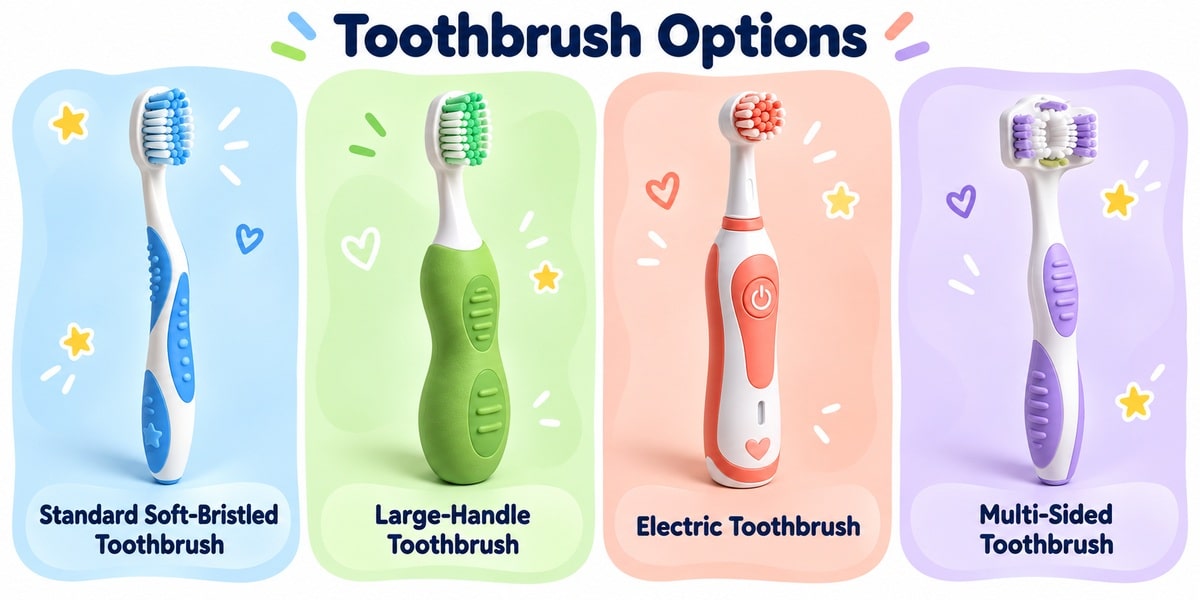
Toothbrushes With Larger Handles
A thin toothbrush handle can be difficult for children with limited grip strength.
A larger handle may improve control and make brushing easier. Some children benefit from specially designed grips or handle adaptations recommended by an occupational therapist.
Electric Toothbrushes
Electric toothbrushes may help children who struggle with repeated brushing movements.
However, they aren't automatically appropriate for every child. Children sensitive to vibration or noise may prefer manual brushing.
Our pediatric oral hygiene guidance includes electric toothbrushes as an option for children who struggle with traditional brushing.
Multi-Sided Toothbrushes
Some toothbrushes have bristles designed to contact several tooth surfaces simultaneously.
These may help certain children, but parents should still check whether the brush cleans the gumline and back teeth effectively.
Ask your pediatric dentist whether a particular design suits your child's needs.
Finding a Comfortable Brushing Position
Children who cannot brush effectively on their own may need caregiver assistance.
A comfortable position can improve visibility and make cleaning easier.
Depending on your child's abilities, consider:
- Supported sitting: Have your child sit in a stable chair with appropriate head and body support.
- Brushing from behind: Stand or sit slightly behind your child to improve visibility.
- Supported reclining: Some younger children tolerate brushing in a gently reclined position.
Children with swallowing difficulties, airway concerns, or significant physical limitations may need individualized positioning recommendations.
Never force your child's head backward or hold their mouth open against significant resistance.
If brushing consistently becomes a physical struggle, ask a dental professional for guidance.
Making Toothbrushing More Predictable
Predictability can help children who find unfamiliar sensations or transitions difficult.
Try using the same simple sequence each time:
- Show the toothbrush.
- Add toothpaste.
- Brush the upper teeth.
- Brush the lower teeth.
- Spit when able.
- Put the toothbrush away.
A visual chart can help children who respond more easily to pictures than verbal instructions.
You might also demonstrate brushing on a doll, let your child hold a second toothbrush, or explain each step before beginning.
Offer choices where appropriate, such as which toothbrush to use or whether to brush the upper or lower teeth first.
The goal is to make brushing easier to understand while maintaining effective cleaning.
Using Fluoride Toothpaste With Sensory Sensitivities
Fluoride toothpaste helps strengthen tooth enamel and prevent cavities.
The American Academy of Pediatrics recommends brushing twice daily with fluoride toothpaste, beginning when the first tooth appears.
Recommended amounts include:
| Age | Fluoride Toothpaste Amount |
|---|---|
| Under 3 years | Rice-grain-sized smear |
| Ages 3 to 6 | Pea-sized amount |
| Older children | Age-appropriate amount with supervision as needed |
Children who have difficulty spitting or swallowing may need individualized guidance.
If your child refuses toothpaste because of its flavor or texture, consider a milder-flavored fluoride toothpaste.
Check the fluoride content rather than selecting a product solely because it is marketed as natural or sensory-friendly.
If your child consistently refuses fluoride toothpaste, speak with their dentist about appropriate alternatives.
For additional guidance, see the American Academy of Pediatrics' fluoride recommendations.
Helping Children Who Cannot Brush Independently
Some children develop independent brushing skills later than others. Some may continue needing assistance into adolescence.
The amount of help should depend on their abilities rather than age alone.
One approach is shared brushing:
- Let your child brush the areas they can manage.
- Help clean surfaces they cannot reach.
- Pay attention to the gumline and back teeth.
- Assist with flossing when neighboring teeth touch.
A child who can hold a toothbrush may still need help cleaning thoroughly.
Building independence is valuable, but effective oral hygiene is the priority.
What if Your Child Cannot Tolerate Brushing?
Repeated gagging, distress, or resistance can indicate that something about brushing needs to change.
Try to identify whether the difficulty involves discomfort, sensory sensitivity, or an oral health concern.
Watch for:
- Tooth pain or sensitivity
- Swollen or bleeding gums
- Visible tooth damage
- Mouth sores
- Difficulty chewing or opening the mouth
A child who suddenly begins resisting brushing after previously tolerating it may need a dental examination.
For ongoing sensory or motor difficulties, an occupational therapist or another healthcare professional may provide additional strategies.
Preventing Cavities When Brushing Is Challenging
Children who need assistance with oral hygiene may have additional cavity risk factors, including dietary needs, medications, or difficulty cleaning their teeth thoroughly.
A practical prevention plan includes:
- Brushing twice daily with fluoride toothpaste
- Providing caregiver assistance as needed
- Limiting frequent sugary snacks and drinks
- Offering water between meals when appropriate
- Maintaining regular dental appointments
- Discussing fluoride treatments and other preventive options with your dentist
We provide preventive pediatric dental care and oral hygiene education to help families develop appropriate routines.
Preparing for Your Child’s Dental Appointment
If your child has physical, developmental, sensory, or emotional needs that may affect their appointment, let us know beforehand.
Helpful information includes communication preferences, sensory triggers, positioning needs, and strategies that make unfamiliar situations easier.
Our pediatric dentists have training in caring for children with special healthcare needs. We adapt our approach to each child's circumstances and use behavior guidance techniques such as Tell-Show-Do and positive reinforcement when appropriate.
Sharing your child's needs helps us discuss what accommodations may be suitable for their visit.
Build a Brushing Routine That Works for Your Child
Children with sensory or motor challenges may need different toothbrushes, additional assistance, or a modified brushing routine.
Start by identifying the most difficult part of brushing and making one manageable adjustment.
If you're concerned about your child's oral hygiene, our pediatric dental team can help you understand their needs and explore appropriate strategies.
We care for children at three Hawaii locations:
- Pearlridge Office, Aiea: 808-487-7933
- Kahala Office, Honolulu: 808-735-1733
- Maui Office, Kahului: 808-877-0066
To discuss your child's oral hygiene needs, contact Pedodontic Associates or call your preferred office to arrange an appointment.
This article provides general educational information and is not a substitute for individualized dental or medical advice.