
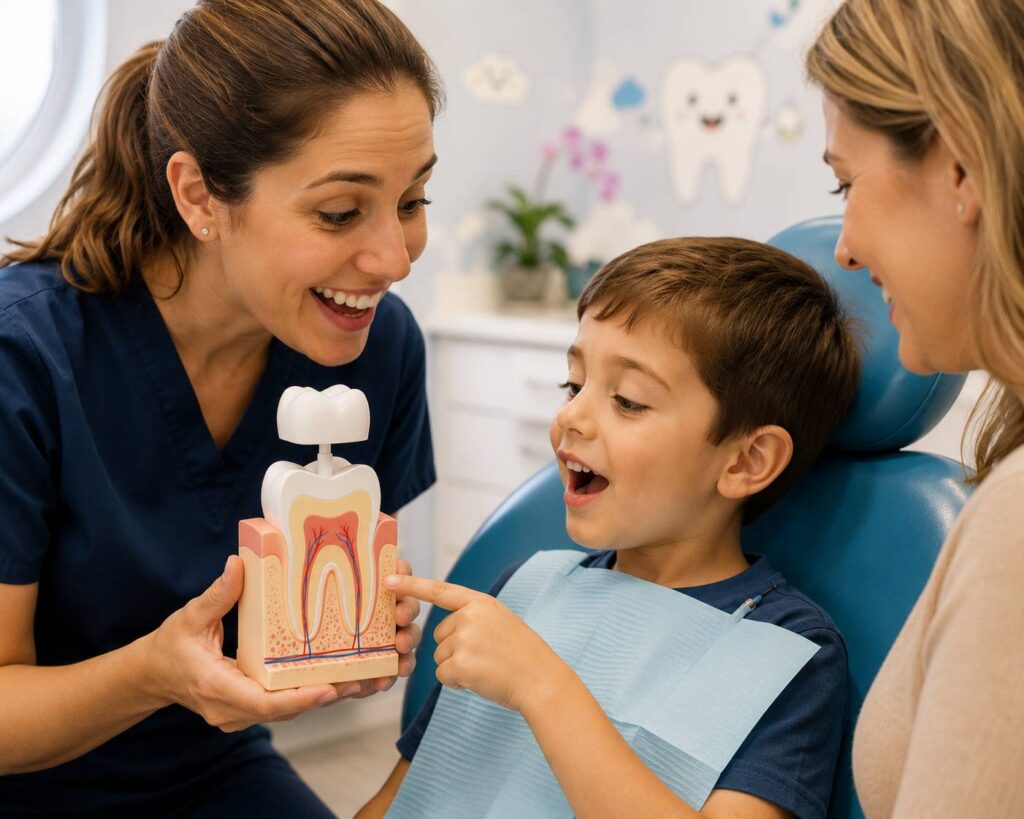
When a pediatric dentist informs you that your child has a cavity, your mind likely jumps to a standard, routine dental filling. You picture a quick, localized patch that fills the small hole left behind by decay. However, during a comprehensive evaluation, you might be surprised to hear a specialist recommend a full pediatric crown instead.
As a parent, this recommendation can raise several immediate questions: Isn’t a dental crown overkill for a temporary baby tooth? Why can’t we just place a large filling for now? What determines when a tooth needs localized restoration versus 360-degree structural protection?
At Pedodontic Associates, we know that understanding the structural differences between these two restorative pathways is essential for eliminating parental anxiety. As a pediatric dentistry home serving Aiea, Honolulu, and Maui since 1977, our clinical team prioritizes non-invasive tooth preservation. We choose between crowns and fillings based on specific structural parameters to ensure your keiki’s smile stays complete.
Anatomy of a Primary Tooth: Why the Rules are Different for Kids
To understand why a pediatric crown is frequently the most conservative choice for a child, it helps to examine basic baby tooth anatomy. Primary teeth are not just smaller versions of adult permanent teeth—they have a completely different internal blueprint:
- Ultra-Thin Enamel Shells: The hard outer enamel shield on a baby tooth is roughly half the thickness of an adult tooth’s enamel.
- Massive Nerve Chambers: The internal living pulp (the nerve center) is significantly larger and sits much closer to the outer surface of the tooth.
Because of this specific structural layout, an active cavity can chew through a baby tooth’s thin enamel shield and penetrate deep into the soft underlying dentin matrix with aggressive speed. By the time a cavity is physically visible between the teeth or on a radiograph, it has often already compromised a massive percentage of the tooth’s overall structural foundation.
Restorations Compared: Local Patch vs. Complete Shielding
While both treatments are designed to clear away active bacterial decay, they serve entirely different structural purposes inside your child’s mouth.
Clinical Trajectory: Standard Filling vs. Pediatric Crown
| Clinical Parameter | Standard Dental Filling Profile | Pediatric Crown (360° Shield) Profile |
|---|---|---|
| Structural Engineering | A localized material patch packed tightly inside a small, multi-walled tooth cavity. | A custom-contoured jacket that completely encases the visible tooth down to the gumline. |
| Enamel Decay Threshold | Ideal for early or moderate decay affecting less than 40% of the visible tooth. | Mandatory for advanced decay consuming more than 50% of the tooth structure. |
| Recurrent Decay Risk | Moderate; bacteria can form new micro-cavities along the border where filling meets enamel. | Extremely low; seals the entire tooth, preventing oral bacteria from ever touching the baby enamel. |
| Structural Longevity | High risk of fracture or falling out if placed inside an excessively large cavity. | Designed to easily endure the heavy, daily grinding forces of chewing until the tooth naturally sheds. |
| Ideal Clinical Use-Case | Small pits on chewing surfaces or minor lesions caught early between molars. | Multi-surface cavities, broken or fractured teeth, or following pediatric nerve therapy. |
Strategic Indicators: When Does a Tooth Require a Crown?
Our pediatric dentists utilize strict diagnostic rules to determine which restorative option will provide the safest, most cost-effective outcome for your child:
The Multi-Surface Rule
If a cavity has spread across two or more surfaces of a single molar (for example, the top chewing surface and the tight wall touching the adjacent tooth), a standard filling becomes clinically unstable. The thin remaining enamel walls of a primary tooth cannot withstand the massive physical pressure of daily chewing. Under that chronic force, the natural tooth walls will eventually fracture away from the filling, requiring a much more complex, secondary emergency intervention. A crown completely bypasses this risk by absorbing 100% of the chewing forces itself.
Following Nerve Therapy (Pulpotomy)
If an aggressive cavity reaches the inner nerve center of a baby molar, a pediatric root canal treatment (pulpotomy) is required to save the root structure. This procedure removes the damaged nerve tissue, which deprives the remaining tooth structure of its natural nutrient and blood supply. As a result, the tooth becomes highly brittle and prone to shattering like glass under normal biting pressure. Placing a 360-degree pediatric crown is a mandatory clinical safety step to completely bind and shield a brittle, post-pulpotomy tooth.
Developmental Enamel Weakness
For children dealing with systemic enamel conditions like hypomineralization (“chalky teeth”), the outer tooth structure emerges from the gums inherently soft and porous. Standard dental fillings cannot bond effectively to structurally weak enamel. Encasing these fragile teeth in a protective pediatric crown provides an immediate, durable shield that stops post-eruptive breakdown in its tracks.
Real Stories: What Hawaii Parents Say About Our Restorative Care
When it comes to deciding between pediatric crowns and fillings, you don’t just have to take our word for it. Our practice’s reputation across Oahu and Maui is built entirely on the trust of local families who have seen firsthand how our specialized team pairs exceptional clinical judgment with deep compassion to keep treatments gentle and long-lasting:
Read Lea V.‘s review of Pedodontic Associates – Kahala on Yelp
Read Shandis C.‘s review of Pedodontic Associates – Kahala on Yelp
Post-Restorative Home Care: Protecting the Dental Investment
Whether your child receives a localized filling or a 360-degree crown, maintaining excellent oral hygiene around the surrounding soft tissues and adjacent teeth is paramount. Our team works hand-in-hand with parents to establish flawless home habits following an appointment:
- The Gumline Focus: When brushing a newly placed pediatric crown, pay close attention to the gumline margin. Use a soft-bristled toothbrush and light, circular motions to clear away plaque biofilm from the border where the crown meets the gum tissue to keep the surrounding area perfectly pink and healthy.
- The Flat Chewing Planes: For filled or crowned teeth, instruct your child to practice a gentle back-and-forth scrubbing motion across the flat chewing surfaces and both the tongue facing surfaces and the cheek facing surfaces of their molars to clear out sticky sugars.
- The Nighttime Flossing Rule: If any two adjacent teeth are touching, they must be flossed. Flossing must be performed consistently at nighttime right before bed. This step is critical because natural saliva flow drops significantly while your child sleeps, leaving neighboring teeth highly vulnerable to overnight acid attacks if food particles remain trapped between tight interproximal spaces.
⚠️ Structural Restorative Disclaimer for Parents: Please note: While a pediatric crown offers an exceptionally durable shield against future decay, childhood tooth decay can expand completely silently beneath the surface without causing immediate toothaches or visible color shifts. The absolute best way to catch decay early—while it can still be fixed with a simple filling or a drill-free peptide fluid rather than a full crown—is through consistent preventive care. Waiting until your child actively complains of tooth pain means the decay has likely already breached the inner nerve center.
Frequently Asked Questions About Pediatric Restorations
1. Why spend money putting a crown on a baby tooth that will just fall out later?
Baby molars do not naturally shed until a child is between 10 and 12 years old. If a severely decayed baby molar is left untreated or receives an unstable, oversized filling that constantly fails, the active bacterial infection can cause painful abscesses, damage the developing permanent adult tooth bud directly underneath, or require an emergency extraction. Saving the primary tooth with a durable crown ensures your child can chew pain-free, speak clearly, and maintain perfect spatial alignment for their adult smile.
2. Will a pediatric crown interfere with how my child’s baby tooth naturally falls out?
No, not at all. A pediatric crown is custom-fitted strictly to the crown (the visible upper portion) of the primary tooth. It does not touch or affect the tooth’s underlying root structure. As the permanent adult tooth grows upward beneath the surface, it will naturally resorb the baby tooth’s roots exactly as it is supposed to. When the time is right, the baby tooth and its protective crown will naturally loosen and fall out together as a single unit.
3. How long does it take for a child to adjust to the feel of a new crown?
Most children adapt to the physical presence of a new dental crown within 24 to 48 hours. Initially, your child might mention that the tooth feels a bit “big” or that their bite feels different as their jaw muscles adjust to the new shape. If they continue to complain of localized discomfort when biting down after three full days, contact our office for a quick, simple bite adjustment.
4. Can a child still get a cavity on a tooth that has a pediatric crown?
The crown itself is made of ceramic or metal, meaning it is completely immune to bacterial acid decay. However, the living root structure underneath the gumline and the surrounding bone remain vulnerable if home oral hygiene is neglected. If plaque biofilm is allowed to continuously collect along the bottom margins where the crown meets the gum tissue, decay can form at the root level. Consistent brushing and regular professional checkups are still vital.
Make the Proactive Choice for Your Child’s Smile
Deciding between a dental filling and a pediatric crown doesn’t have to be a source of stress or confusion. By partnering with our pediatric specialists, you can secure a clear, structurally sound restorative blueprint designed to protect your keiki’s comfort, save their primary teeth, and establish a completely healthy foundation for their adult smile.
Explore our locations and plan your family’s visit using our office tour links below:
- Aiea Office: Explore our Aiea dental office tour right by Pearlridge Center, providing a convenient hub for Central and West Oahu families.
- Honolulu Office: Visit our Honolulu dental office tour centrally positioned to serve busy parents across Metro Honolulu.
- Maui Office: See our Maui dental office tour located in Kahului, ensuring neighbor island families have direct access to cutting-edge pediatric care.
With three convenient locations across Oahu and Maui and accommodating Saturday appointment blocks, Pedodontic Associates makes it simple to prioritize your child’s oral health around your busy family routine. Contact Us today to schedule an evaluation!
Medical & Legal Disclaimer: The content on this blog is provided for general informational purposes only and is not intended as medical advice, diagnosis, or treatment. Always seek the advice of a qualified pediatric dentist regarding your child’s specific oral health needs. If your child is experiencing a severe medical emergency, such as extreme facial swelling, a high fever, or difficulty breathing, call 911 or proceed to the nearest emergency room immediately.