

You notice a small white bump on your child's gums while helping them brush. Maybe it looks like a pimple, or perhaps there's a swollen area near a tooth that wasn't there yesterday.
It's natural to wonder whether the bump is part of normal tooth development or a sign of something that needs treatment.
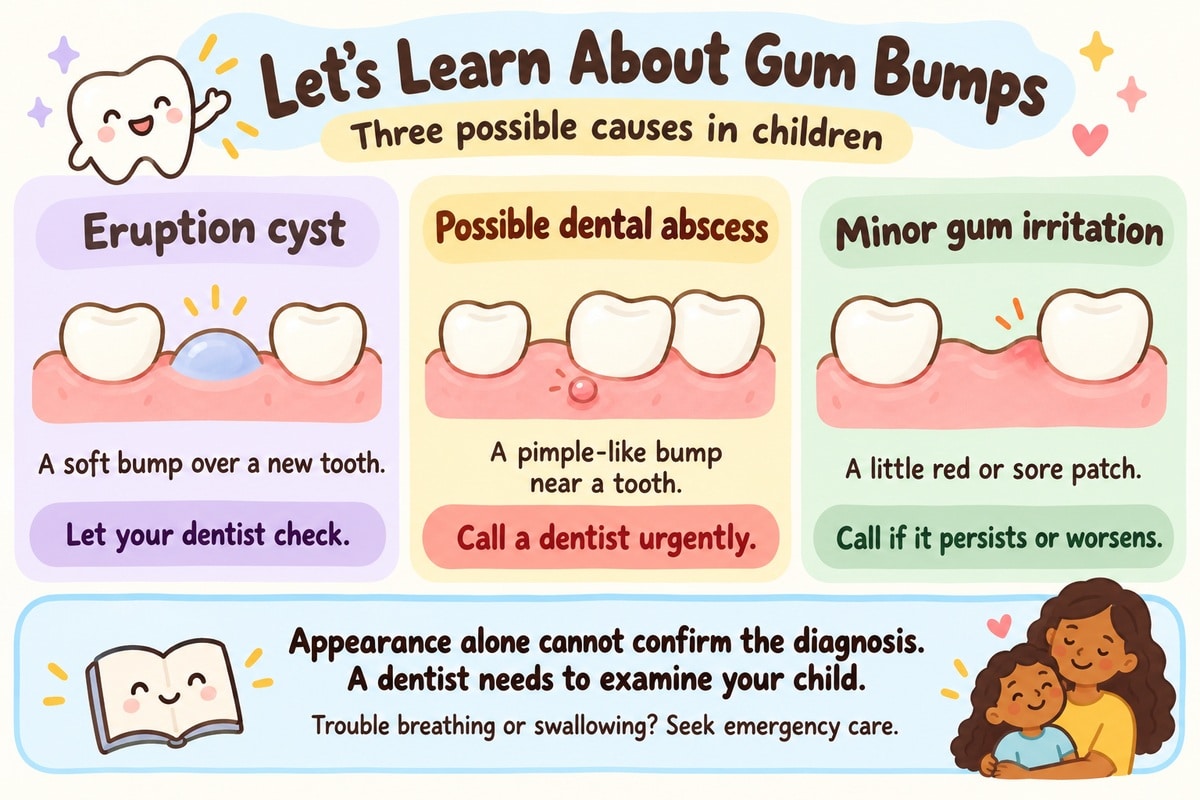
A bump on your child's gums can have several causes, including an erupting tooth, irritation, or a dental infection. Some bumps resolve without treatment, while others need prompt dental attention. Appearance alone isn't enough to determine the cause.
At Pedodontic Associates, we help families across Oahu and Maui understand changes in their children's oral health. Here's what parents should know about common causes of gum bumps, warning signs and when to call a pediatric dentist.
What Causes a Pimple-Like Bump on a Child’s Gums?
The location, color and appearance of a gum bump can provide clues about what may be happening.
However, different conditions sometimes look similar. A pediatric dentist may need to examine the area before determining whether treatment is necessary.
1. Dental Abscess or Gum Boil
A small pimple-like bump near a tooth can sometimes be a sign of a dental infection.
When bacteria infect the tissues inside or around a tooth, an abscess may develop. In some cases, the infection creates a drainage pathway that appears as a small bump on the gums, sometimes called a gum boil or parulis.
Parents may notice:
- A white or yellow bump near a tooth
- Swelling or redness around the affected area
- Tooth pain or sensitivity
- An unpleasant taste or drainage from the bump
- Discoloration of a nearby tooth
A dental infection doesn't always cause significant pain. If an abscess is draining, discomfort may decrease even though the underlying infection remains.
That's why a painless gum pimple should not automatically be considered harmless.
Untreated tooth decay is one possible cause of dental infection. You can learn more about how decay develops and the available treatment approaches on our children's cavities page.
If you suspect a gum boil, contact a dentist promptly rather than waiting for the bump to disappear.
2. Eruption Cyst: A Bump Over a Tooth Coming In
Sometimes a bump appears because a new tooth is moving through the gums.
An eruption cyst is a fluid-filled swelling that can develop in the soft tissue covering an emerging tooth. It can occur when baby teeth or adult teeth are coming in.
Unlike a gum boil caused by infection, an eruption cyst is associated with tooth development.
According to the American Academy of Pediatric Dentistry's guidance on pediatric oral conditions, eruption cysts can vary in color from normal gum tissue to blue, brown or nearly black.
A darker eruption cyst containing blood is sometimes called an eruption hematoma.
Many uncomplicated eruption cysts resolve as the tooth comes through the gums and do not require treatment.
However, parents should not assume that every swelling above an erupting tooth is an eruption cyst. If the area is painful, becomes increasingly swollen, or doesn't resolve, arrange a dental examination.
3. Irritation or Minor Injury
Children sometimes injure their gums while eating, brushing, or playing.
A sharp food fragment, accidental bite, or minor scrape may irritate the gum tissue.
In some cases, the irritated area looks swollen or develops a small sore.
A recent injury can help explain why a bump appeared, but it does not rule out another dental problem.
If your child has persistent swelling, significant discomfort or a sore that does not heal, contact a dental professional.
4. Other Oral Lesions
Not every bump in a child's mouth comes from a tooth.
Certain cysts, salivary gland conditions or other soft-tissue changes can produce a lump inside the mouth.
For example, a mucocele is a mucus-filled lesion associated with a minor salivary gland. These are more commonly found on the inner lower lip than directly on the gums.
Because different oral conditions may have similar appearances, unusual or persistent lumps should be professionally evaluated rather than diagnosed from a photograph or online description.
How Can You Tell Whether a Gum Bump Is Serious?
The most important factors are your child's symptoms, whether swelling is spreading, and whether there are signs of infection.
The following table can help you decide when to seek professional care.
| What you notice | Possible concern | Recommended action |
|---|---|---|
| Small bump over a tooth that's coming in, without other symptoms | Possible eruption cyst | Contact your pediatric dentist for advice, particularly if the diagnosis is uncertain or the bump persists. |
| White or yellow pimple near an existing tooth | Possible dental abscess or drainage tract | Contact a dentist promptly. |
| Gum bump with tooth pain or tenderness | Possible infection or irritation | Arrange a prompt dental evaluation. |
| Gum swelling with fever or facial swelling | Possible spreading infection | Seek urgent professional assessment. |
| Rapidly spreading swelling, trouble breathing or difficulty swallowing | Potential medical emergency | Call 911 or go to the emergency department immediately. |
| Persistent unexplained lump | Oral condition requiring diagnosis | Schedule a dental examination. |
Don't rely on pain alone to judge whether a gum bump needs attention. Some dental infections have few noticeable symptoms, particularly when fluid can drain through the gums.
If you're unsure what you're seeing, call our office and describe the symptoms.
Can a Child Have a Gum Abscess Without Tooth Pain?
Yes. A child may develop a dental infection without experiencing a constant toothache.
For example, when an infection drains through a small opening in the gums, pressure may decrease and pain may become less noticeable.
However, the source of the infection may still be present.
A tooth can also develop problems after a previous injury. Parents may notice a change in tooth color or a small bump on the gum near the injured tooth.
These symptoms deserve a dental evaluation even when the child is eating and playing normally.
If you notice a pimple-like bump near a tooth, particularly one that has been injured or affected by decay, don't attempt to diagnose the problem at home.
What Should You Do if You Find a Bump on Your Child’s Gums?
There are a few practical steps you can take before your child is examined.
Avoid Popping or Squeezing the Bump
Do not try to drain a suspected abscess yourself.
Puncturing or squeezing the gum tissue may cause additional injury and does not address an infection within or around the tooth.
Even if the bump opens and drains on its own, your child may still need dental treatment.
Continue Gentle Oral Hygiene
Help your child brush carefully around the affected area using a soft-bristled toothbrush.
Avoid aggressive brushing or attempting to scrape the bump.
If the area is uncomfortable, encourage your child to avoid hard or sharp foods that may irritate it.
Older children who can reliably rinse and spit may find a gentle warm saltwater rinse soothing, but this is not a treatment for dental infection.
Keep Track of Changes
It may help to note:
- When you first noticed the bump
- Whether it has changed in size or color
- Whether your child has pain, fever or difficulty eating
- Whether a nearby tooth has changed color
- Whether your child recently injured their mouth
A photograph taken for your own reference may help document changes, but it cannot replace a clinical examination.
Contact a Pediatric Dentist
A suspected abscess needs prompt assessment. A bump that looks like an eruption cyst may also need evaluation if you're uncertain about its cause.
If swelling is increasing rapidly, your child has trouble swallowing or breathing, or they appear seriously ill, seek emergency medical attention.
What Happens During a Pediatric Dental Examination?
When you bring your child to us with a gum bump, we'll begin by examining the affected area and the nearby teeth.
We'll ask about symptoms and relevant dental history, including any recent injuries.
Depending on what we find, the examination may include checking for decay, evaluating the gums, and assessing whether a tooth is erupting normally.
Dental X-Rays May Be Recommended
Some dental problems are not fully visible above the gumline.
When clinically appropriate, dental X-rays can help us evaluate tooth structure and surrounding tissues.
You can learn more about the role of imaging on our dental X-rays page.
Not every gum bump requires imaging. The decision depends on the clinical findings.
Treatment Depends on the Cause
If the bump is associated with normal tooth eruption and there are no complications, treatment may not be necessary.
If the problem involves a cavity or infected tooth, dental treatment may be needed to address the underlying cause.
Depending on the condition of the tooth, treatment possibilities can include pulp therapy or extraction. Some oral conditions require referral to an appropriate specialist.
Our team discusses examination findings and appropriate treatment options with parents, including when additional evaluation or referral is needed.
We also use child-focused behavior guidance, including Tell-Show-Do and positive reinforcement, to help children understand their appointments.
For more information about our approach, visit our pediatric dentistry page.
How to Help Protect Your Child’s Gums and Teeth
Not all oral bumps can be prevented. Eruption cysts, for example, are related to tooth development rather than poor brushing.
However, preventive dental care can help reduce the risk of cavities and related infections.
Maintain a Consistent Brushing Routine
Help your child brush twice daily with an age-appropriate amount of fluoride toothpaste.
Young children often need hands-on help, especially around the back teeth and gumline.
Floss between teeth that touch and encourage gentle brushing rather than excessive pressure.
Address Tooth Decay Early
Cavities do not always cause noticeable pain when they first develop.
Regular dental examinations can help identify decay before it progresses to more extensive damage.
If your child has a visible cavity, tooth sensitivity or persistent discomfort, contact your dentist for an evaluation.
Keep Up With Dental Checkups
We generally recommend routine dental checkups every six months, with the schedule adjusted according to each child's needs.
These visits allow us to monitor developing teeth, check gum health and discuss concerns you may have noticed at home.
For additional home-care guidance, explore our children's oral hygiene recommendations.
Have You Noticed a Bump on Your Child’s Gums?
Finding an unfamiliar bump in your child's mouth can be concerning, especially when you're unsure whether it's related to a tooth coming in or an infection.
Some gum bumps are temporary changes associated with development. Others need professional evaluation and treatment.
If your child has a new, persistent or pimple-like bump on their gums, contact our pediatric dental team.
We provide pediatric dental care for families on Oahu and Maui through three offices:
| Office | Location | Phone |
|---|---|---|
| Pearlridge Office | Aiea, Oahu | 808-487-7933 |
| Kahala Office | Honolulu, Oahu | 808-735-1733 |
| Maui Office | Kahului, Maui | 808-877-0066 |
Our Pearlridge and Kahala offices also offer Saturday appointments. Please call to confirm current availability.
For office information and non-urgent correspondence, visit our contact page.
Call our nearest office to discuss your child's symptoms and arrange an appropriate dental evaluation.
Medical disclaimer: This article provides general educational information and is not a substitute for professional dental or medical advice, diagnosis, or treatment. If your child has difficulty breathing or swallowing, rapidly spreading facial swelling, or another serious medical emergency, call 911 or seek emergency medical care.